17 November 2026
Pasta di Gragnano: history and production
Pasta di Gragnano: history and production
To discover the origins of pasta production in Gragnano We must go to the end of the sixteenth century, the date of the appearance of the first family-run pasta factories. Gragnano's history and fame in the pasta production sector began on July 12, 1845. King Frederick II of Bourbon allowed the pasta makers to provide the court of all the long pastas. From that date Gragnano officially became the City of Macaroni.
In fact, the tradition of pasta has even more distant roots. Already the Ancient Rome wheat was milled in Gragnano thanks to the strength of the waters of the Vernotico stream and in the Valle dei Mulini. The flour obtained became the basis for preparing bread and feeding the cities of Pompeii, Herculaneum and Stabiae.
Over time the poor classes had the power to have stocks of durum wheat and this led to the first production of dry pasta, an important activity rooted in Naples in 1500 and carried out by the Corporation of “vermicellars”. However, until the seventeenth century pasta was a food not widespread and its discovery occurred as a result of the famine that struck the kingdom of Naples. In a short time it became a fundamental food for nutritional qualities and a sort of low-cost white gold.
Gragnano and the tradition of pasta production
The soils used to produce wheat were those of Gragnano and Naples for the ideal microclimate, made of wind, sun and right humidity. 30 water mills contributed to the development of the pasta industry and from 1783, due to the crisis in the textile sector, Gragnano became the home of the ‘manufactory of pasta”.
The golden age, however, is 1800, when the great pasta factories were built, exposing macaroni to dry along Via Roma and Piazza Trivione, with production reaching its peak in the middle of the century. It is estimated that the 75% of the working population worked in the macaroni industry, with over 100 pasta factories producing as much as 1000 quintals of pasta per day. Via Roma, symbol of Gragnano Pasta, became a real natural open air dryer for vermicelli and ziti.
After the union of Italy in 1861, macaroni were brought to the markets of Turin, Florence and Milan and a pasta export railway was created linking Gragnano to Naples in the presence of King Umberto I and Queen Margherita of Savoy. Electricity will then replace the old hand-operated presses.
The twentieth century saw a decrease in activity for the nascent Northern industry and the few remaining pasta factories focused on quality to overcome the World Wars and win the competition of Northern Italy. Even in the earthquake of 1980 aggravated the situation, but despite everything Gragnano is still the City of Pasta.
The secrets of a centuries-old recipe
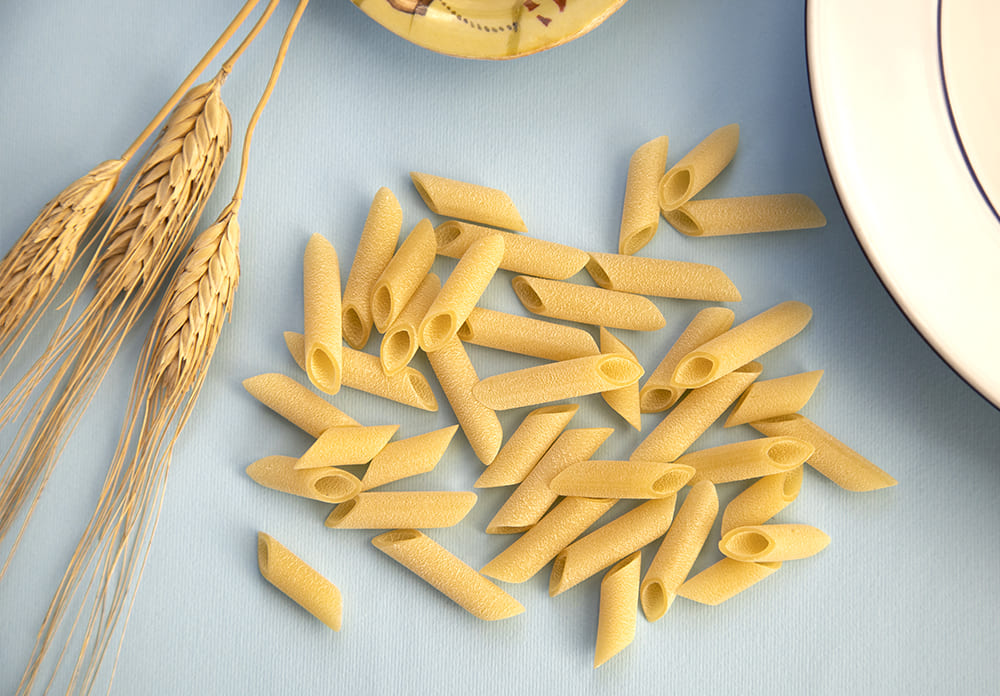
The particularity of the Pasta of Gragnano is given by craftsmanship handed down from generation to generation. This product is composed of durum wheat semolina flour dried at low temperature and bronze drawn, to obtain a wrinkled surface that retains any seasoning, even in the case of smooth formats.
Defined as white gold as early as the 19th century, pasta was the democratic food par excellence served on the table of the nobles of the Kingdom of Italy, but also in the Neapolitan lower class and still represents the Italian product par excellence, known and exported all over the world.
In 2013 the Pasta of Gragnano has obtained the PGI certification at European level, the highest recognition for an artisan tradition that has been handed down for centuries and has made this territory famous.
Pasta factory in Aragon: excellence and love for pasta

The Pastificio d’Aragona Gragnano PGI was born in 2013 from fifty years of experience in the world of white art, which generation after generation has come down to us to enhance one of the typical and most representative products of Campania.
The company’s logo evokes the Gragnano of the 19th century, characterised by the processing of pasta using completely artisan techniques, and Pastificio d’Aragona is a company that offers the final consumer a high-quality, tasty and genuine product.
A package of Aragonese pasta encloses the history, passion and tradition It tells the story of the city’s love for macaroni.